Fine Art Oil Painting of Long Dark Woman With Sharp Nose

The Ugly Duchess aka "A Grotesque onetime Adult female", 1513 64.2 × 45.5 cm. National Gallery, London

The Ugly Duchess (also known as A Grotesque Old Woman ) is a satirical portrait painted by the Flemish artist Quentin Matsys around 1513.
The painting is in oil on an oak panel, measures 62.4 by 45.5 cm.[1] It shows a grotesque one-time adult female with wrinkled skin and withered breasts. She wears the aristocratic horned headdress (Escoffion) of her youth, out of fashion past the time of the painting, and holds in her correct hand a red flower, then a symbol of appointment, indicating that she is trying to concenter a suitor. However, it has been described equally a bud that volition 'probable never blossom'. The work is Matsys' all-time-known painting.[2]
The painting was long thought to have been derived from a putative lost work by Leonardo da Vinci, on the footing of its striking resemblance to two caricature drawings of heads unremarkably attributed to the Italian artist. However the caricatures are now thought to be based on the work of Matsys, who is known to have exchanged drawings with Leonardo.[3]
A possible literary influence is Erasmus's essay In Praise of Folly (1511), which satirizes women who "still play the coquette", "cannot tear themselves away from their mirrors" and "practise not hesitate to exhibit their repulsive withered breasts".[two] The woman has been oftentimes identified equally Margaret, Countess of Tyrol, claimed past her enemies to exist ugly;[4] yet, she had died 150 years earlier.
The painting is in the collection of the National Gallery in London, to which it was ancestral by Jenny Louisa Roberta Blaker in 1947.[1] Information technology was originally half of a diptych, with a Portrait of an Old Human, in the Musée Jacquemart-André, Paris, which was lent to the National Gallery in 2008 for an exhibition in which the two paintings were hung next.[3]
The portrait is thought to be a source for John Tenniel'south 1869 illustrations of the Duchess in Alice'due south Adventures in Wonderland.[5]
A 1989 article published in the British Medical Journal speculated that the discipline might have suffered from Paget'southward disease,[half-dozen] in which the victim's bones enlarge and become plain-featured. A similar suggestion was made by Michael Baum, emeritus professor of surgery at Academy College London.[3]
Description [edit]
The painting is in oil on an oak panel, measures 62.4 by 45.five cm.[7] It shows an old woman depicted with exaggerated features. She has a short nose with upturned flared nostrils. Her upper lip is elongated and her mouth appear thin and pinched. The peel of her cheeks, neck and jaw hang loose on her face. The residuum of her peel is wrinkled and pocked, and she has a wart on the right side of her face. Her thinning hair, concealed by a horned headdress, is swept behind protruding ears. Despite her seemingly "ugly" visage, she wears aloof fashion that is more than relevant to her youth rather than her advanced age. Her clothing is an adaptation of traditional Burgundian manner, popular between 1400 and 1500. By the time Matsys completed this piece of work, in 1513, this style of dress was already out of style. Her dress, with tightly laced corseted front, pushes her wrinkled breasts upwards beyond propriety standards for the catamenia. Her shoulders are covered by a white veil, that falls from her horned headdress. It is decorated in roses and ornamented by a large gilded and pearl broach. Her fine, simply out of manner, vesture suggests she was a wealthy woman. Additionally, she holds a red flower in her correct mitt. At ane time a ruby flower symbolized engagement, or courtship.[7] With her ugly features and advanced age, this red bloom simply adds to the satirical nature of Matsys'southward work.
Technical Analysis [edit]
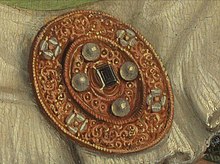
Detailed close-up of the ornamental brooch featured in Matsys'southward work, The Ugly Duchess. Shows the fine brushwork and layered colorwork.
The painting technique reflects Matsys himself and is similar to his other work. The paint is worked in many places moisture-in-wet and has been dragged and feathered. Matsys popularly used feathering to soften and blend transitions of tone.[viii] The pilus almost the Duchess's right ear and the embroidery on her right gage are rendered in sgraffito, a technique done by scratching through a layer of moisture paint to testify the underlying layers.[9] Matsys achieved the uneven appearance of her flesh by layering the basic pink with red and white dots in sporadic dashes and blotches. Matsys displays finer attention to detail through his brushwork when looking at the ornamental brooch. In the brooch are at least five shades of brown, orange, pink and xanthous to accomplish its golden hue.[seven]
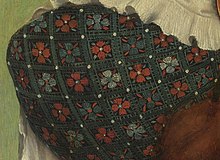
Detailed close-up of the horned headdress in Matsys's work, The Ugly Duchess. Produced using the sgraffito method.
Infrared assay of the painting shows that the face was carefully washed, whereas the clothes and other elements were freer and more than sketchy. For the face, Matsys may have carefully followed a preliminary drawing simply fabricated several changes. He drew the eyes twice, moving them slightly higher and to the right. He so decreased the final appearance of the mentum, neck and right ear, visible by comparison the paint to the nether drawing. Another change between the under drawing and paint are the right shoulder and both hands, which were shifted and differently posed.[7]
Matsys painted the two horns of the headdress by different methods. On the correct, the horn's stripes were made past sgraffito. He removed the red, white and blue to reveal the black layer underneath. The horn on the left, Matsys used the contrary method. He applied black pigment on top of a multicolored layer. Though the work is largely attributed to Quentin Matsys, he did accept a drove of administration assisting him. The inconsistencies and changes in method could be attributed to the work of unlike assistants, or perhaps reflect a change in method from Matsys himself.[7] [10]
Interpretation [edit]
Satire [edit]
The Ugly Duchess has commonly been interpreted as a work of satire. The woman depicted is dressed in the finest apparel, and holds a red flower that symbolizes date. She is fit to represent youth, but her grotesque appearance makes that impossible. Scholars today consider this Matsys'due south attempt to satirize cloth civilization. Especially preying on the elderly or those obsessed with maintaining an youthful appearance. Her appearance prompts the audition to consider the relationship between internal and external dazzler. Externally, based on her exquisite dress, jeweled accessories, and budding flower, this woman was theoretically beautiful. However, her internal beauty is reflected in her exaggerated and displeasing physical appearance.[xi] Refer too to Erasmus'south essay In Praise of Folly (1511), which satirizes women who "nevertheless play the coquette", "cannot tear themselves abroad from their mirrors" and "practise not hesitate to showroom their repulsive withered breasts".[12] [thirteen] With the completion engagement estimated to be 1513 for The Ugly Duchess it is highly probable that Erasmus's essay influenced Matsys'southward product.
Medical Condition: Paget'due south Disease [edit]
In 1877 Sir James Paget observed a medical disorder where the bones became inflamed and malformed. He formally coined the condition "osteitis deformans," but by the end of the century it became known as Paget'southward Disease.[fourteen] Though formal identification of the illness did not be until 1877, in that location are accounts that propose its been around for far longer. Scholars now are using The Ugly Duchess to prove that the disease existed every bit early as the 16th century. A 1989 article published in the British Medical Journal and emeritus professor of surgery at University Higher London, Michael Baum also offer speculation on the Duchess's diagnosis with Paget's.[xv] While much of the discussion concerning Paget'due south disease focuses on the physical representation of the condition, scholar Sarah Newman suggests that the portrait also provides cultural insight into how disability was viewed in the sixteenth century. She argues that the portrait reflects a cultural transition from an before model of disability, where it was typically depicted exclusively as extreme or abnormal, to a more familiar model, i which depicts individuals engaged in daily commercial or personal activities that exercise not strike the viewer as exceptionally abnormal.[16] Newman's study contributes to understanding Matsys and the broader Dutch emblematic and portraiture traditions, and shows the value of historic representations in the broader written report of disability. Historian Gretchen Eastward. Henderson'south volume Ugliness: A Cultural History follows a similar line of discussion, only focuses on the interpretation of inability in artwork. Henderson presents the thought that focusing on disability the interpretation of The Ugly Duchess becomes more than sympathetic rather than a report in satire.[17] As a sufferer of Paget'southward disease, the woman no longer appears the fool holding a blood-red blossom that will never bloom, but a victim of unfortunate circumstances. These alternative interpretations rely on the assumption that Matsys used a live model for this portrait. While many possible identities have been suggested for the adult female, none are disarming.
Influence [edit]
Quentin Matsys and Leonardo Da Vinci [edit]
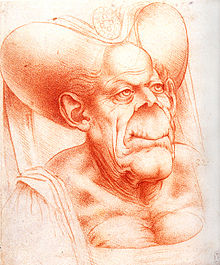
In 1490, Leonardo da Vinci created a series of sketches he called Grotesque Heads. Included in that series was a sketch that looked remarkably similar to Matsys'due south Ugly Duchess. With the earlier cosmos date in that location is some fence equally to who the original creator is. It is well known that Matsys and da Vinci corresponded and shared work during their careers. When the Duchess was completed, many attributed its influence to the work of da Vinci since he already had a collection of caricature heads. However, when considering the under drawing and primary sketches beneath the paint, scholars now believe that Matsys had created the Duchess long earlier the portraits completion. The now popular theory is that Matsys sent da Vinci an early on sketch that so inspired the Italian artist to copy the exaggerated course of the woman'due south grotesque features.[15]
John Tenniel's illustration in Alice's Adventures in Wonderland [edit]

Many scholars today believe that Matsys influenced John Tenniel's analogy of the Duchess in Alice's Adventures in Wonderland. Author Lewis Carroll did not explicitly depict the Duchess's face in his volume. Carroll described the character in affiliate nine, stating "Alice did not much like keeping then close to her: beginning, because the Duchess was very ugly; and secondly, because she was exactly the right pinnacle to rest her mentum upon Alice's shoulder, and information technology was an uncomfortably sharp mentum."[xviii] Rather than finding inspiration in Carroll'south writing, Tenniel turned to the portrait of The Ugly Duchess. There are differences, Tenniel softened some of the harshness found in Matsys's piece of work. Tenniel'southward Duchess has a lower headdress, and the large ears, leathery neck and breasts prominent in the original portrait, are curtained. Tenniel presents an ugly woman, only not a frightening one. She will upset children, much like the ane she is property in the illustration, but she volition not scare them like her predecessor.[xix]
Provenance [edit]
Completed in 1513 as half of a diptych, with a Portrait of an Old Human being. The portraits were at one point separated and barbarous into private collections. In 1920 The Ugly Duchess appeared at auction in New York City, New York.[17] Later, in 1947, Jenny Louisa Roberta Blaker bequeathed the portrait to The National Gallery in London where it remains today.[vii]
Gallery [edit]

References [edit]
- ^ a b "Quinten Massys An Old Woman (The Ugly Duchess)". The National Gallery. Archived from the original on 22 October 2012. Retrieved eleven October 2012.
- ^ a b Grössinger, Christa (1997). Picturing women in late Medieval and Renaissance art. Manchester: Manchester University Press. p. 136. ISBN0-7190-4109-0.
- ^ a b c Chocolate-brown, Marker (2008-ten-xi). "Solved: mystery of The Ugly Duchess - and the Da Vinci connection". The Guardian . Retrieved 2012-04-xxx .
- ^ "SELL UGLIEST PORTRAIT.; Motion picture of Duchess Brings 880 Guineas at Christie's". New York Times. 1920-01-24. Retrieved 2012-04-30 .
- ^ Gardner, Martin, ed. (1960). The Annotated Alice. New York: Bramhall Firm. p. 82.
- ^ Dequeker, J. (23 December 1989). "Paget's disease in a painting past Quinten Metsys (Massys)". British Medical Journal. 299 (6715): 1579–1581. doi:10.1136/bmj.299.6715.1579. PMC1838767. PMID 2514922.
- ^ a b c d e f "Quinten Massys An Old Woman (The Ugly Duchess)". The National Gallery. Archived from the original on 22 October 2012. Retrieved 11 October 2012.
- ^ Argent, Larry, 1947- (1984). The paintings of Quinten Massys with catalogue raisonné. Metsys, Quentin, 1465 or 1466-1530. Montclair, N.J.: Allanheld & Schram. ISBN0-8390-0322-half dozen. OCLC 10532905.
{{cite book}}: CS1 maint: multiple names: authors listing (link) - ^ "Sgraffito | art". Encyclopedia Britannica . Retrieved 2020-10-26 .
- ^ Spring, Marika (2017-09-19). "New insights into the materials of fifteenth- and sixteenth-century Netherlandish paintings in the National Gallery, London". Heritage Science. five (1): 40. doi:10.1186/s40494-017-0152-iii. ISSN 2050-7445.
- ^ Shaffer, Katie. "The Ugly Duchess by Quentin Massys - An analysis".
- ^ Grössinger, Christa (1997). Picturing women in tardily Medieval and Renaissance fine art. Manchester: Manchester Academy Press. p. 136. ISBN0-7190-4109-0.
- ^ The Oxford lexicon of fine art and artists. Chilvers, Ian. (Fourth ed.). Oxford. 2009. ISBN978-0-19-953294-0. OCLC 269433597.
{{cite book}}: CS1 maint: others (link) - ^ Galea, Yard.; Cannataci, C.; Azzopardi, C.; Mizzi, A.; Cortis, K. (2016-03-02). "Paget's illness of the os - Imaging the appendicular skeleton". ECR 2022 EPOS . Retrieved 2020-10-27 .
- ^ a b Chocolate-brown, Marking (2008-x-11). "Solved: mystery of The Ugly Duchess - and the Da Vinci connection". The Guardian . Retrieved 2012-04-thirty .
- ^ Newman, Sara (2014). "Portrait of Sixteenth-Century Disability? Quentin Matsys's A Grotesque Old Woman". The Review of Disability Studies. hdl:10125/58604. ISSN 1552-9215.
- ^ a b Henderson, Gretchen E. (2015-eleven-15). Ugliness: A Cultural History. Reaktion Books. ISBN978-i-78023-560-8.
- ^ "The Project Gutenberg eBook of Alice'southward Adventures in Wonderland, by Lewis Carroll". world wide web.gutenberg.org . Retrieved 2020-xi-17 .
- ^ "The Ugly Duchess: She was everything a woman wasn't supposed to be - ProQuest". search.proquest.com . Retrieved 2020-11-17 .
External links [edit]
- "An Old Adult female ('The Ugly Duchess')". The National Gallery, London. Retrieved 2012-04-30 .
Source: https://en.wikipedia.org/wiki/The_Ugly_Duchess

Post a Comment for "Fine Art Oil Painting of Long Dark Woman With Sharp Nose"